replayr reads 37 file extensions in 33 recording
formats: TASPROJ and GBMV files have the structure of BK2, TAS that of
BKM, FM3 that of FM2, and HGM that of Hourglass WTF; the extension TXT
is that of two formats, those of the Atari Grand Challenge and
Atari-HEAD data sets, which are told apart by their first line. A format
can serve several platforms and controller layouts. For example, a BK2
file can contain a calculator keypad, a PlayStation pad, or a computer
keyboard; its named fields determine the imported controls.
The tables identify supported layouts, format versions, and the recordings used to check them. External checks cover 7,385 distinct recordings obtained from TASVideos, including obsolete publications, and 3,893 further files for the formats that TASVideos holds few or none of. These checks are documented in the repository’s validation folder, which lists the source of every file and provides the scripts to repeat them. The package includes original artificial examples for testing and demonstration.
Platforms
The names and codes follow the TASVideos system list, with familiar regional names added where useful. Numbers in parentheses count distinct recordings in each platform–format combination. The format and device qualifications below describe which fields have a decoded interpretation.
A platform label can describe a game’s original release platform while the recording captures input to another application. The Android-labelled example, for instance, uses Ruffle through libTAS. The CD-i and some Mac OS recordings use MAME through libTAS; PC-98 examples use Neko Project through libTAS or Hourglass. Flash, PICO-8, and Web recordings likewise use host-level input logs. Linux and Windows applications are represented under the archive’s IBM PC compatible label. These distinctions matter when interpreting key codes and pointer coordinates.
| Platform | Archive code | Formats (recordings checked) |
|---|---|---|
| 3DO | 3DO |
BK2 (3) |
| Adobe Flash | Flash |
LTM (269) |
| Amiga | Amiga |
BK2 (14) |
| Android | Android |
LTM (1) |
| Apple II | AppleII |
BK2 (5) |
| Arcade | Arcade |
BK2 (101), FBM (62), LTM (8), MAR (21) |
| Atari 2600 | A2600 |
BK2 (140), BKM (24) |
| Atari 7800 | A7800 |
BK2 (11), BKM (2) |
| Atari Jaguar | Jaguar |
BK2 (1) |
| Atari Jaguar CD | JaguarCD |
BK2 (2) |
| Atari Lynx | Lynx |
BK2 (9), MCM (1) |
| CD-i | CDi |
LTM (1) |
| ColecoVision | Coleco |
BK2 (26), BKM (2) |
| Commodore 64 | C64 |
BK2 (169) |
| Fairchild Channel F | ChannelF |
BK2 (2) |
| Famicom Disk System | FDS |
BK2 (11), FCM (12), FM2 (21), FMV (10) |
| Game Boy | GB |
BK2 (177), BKM (7), LSMV (3), VBM (106) |
| Game Boy Advance | GBA |
BK2 (274), GBMV (36), VBM (224) |
| Game Boy Color | GBC |
BK2 (186), BKM (14), LSMV (6), VBM (76) |
| Game Gear | GG |
BK2 (28), BKM (1), MMV (3) |
| IBM PC compatible | PC |
BK2 (18), CTAS (4), DFT (1), LMP (19), LTM (129), WTF (37) |
| IBM PC DOS | DOS |
BK2 (37), JRSR (76), LTM (11) |
| Intellivision | INTV |
BK2 (50) |
| Java 2 Platform, Micro Edition (J2ME) | J2ME |
BK2 (1) |
| Mac OS / macOS | MacOS |
LTM (3) |
| MSX Home Computer System | MSX |
BK2 (4), OMR (29) |
| NEC PC-98 | PC98 |
LTM (1), WTF (1) |
| Neo Geo Pocket | NGP |
BK2 (7) |
| Nintendo 3DS | 3DS |
BK2 (22), CTM (5) |
| Nintendo 64 | N64 |
BK2 (74), BKM (4), GZM (1), M64 (85) |
| Nintendo 64DD | N64DD |
BK2 (1) |
| Nintendo DS | DS |
BK2 (88), DSM (124) |
| Nintendo DSi | DSi |
BK2 (7) |
| Nintendo Entertainment System / Famicom | NES |
BK2 (505), BKM (10), FCM (479), FM2 (807), FM3 (19), FMV (232), TAS (1), TASPROJ (1) |
| Nintendo GameCube | GC |
DTM (140) |
| Odyssey 2 / Videopac | O2 |
BK2 (8) |
| PC Engine / TurboGrafx-16 | PCE |
BK2 (27), BKM (4), MC2 (7), MCM (5) |
| PC Engine CD / TurboGrafx-CD | PCECD |
BK2 (8), MC2 (6) |
| PC-FX | PCFX |
BK2 (1) |
| PICO-8 | PICO8 |
LTM (21) |
| Satellaview | BSX |
BK2 (2), SMV (3) |
| Sega 32X | 32X |
BK2 (6), GMV (5) |
| Sega CD / Mega-CD | SegaCD |
BK2 (20), GMV (9) |
| Sega Genesis / Mega Drive | Genesis |
BK2 (227), BKM (4), GMV (364) |
| Sega Master System | SMS |
BK2 (84), BKM (8), MMV (32), TAS (3) |
| Sega Saturn | Saturn |
BK2 (24), BKM (1), YMV (2) |
| Sega SG-1000 | SG1000 |
BK2 (5), BKM (1) |
| Sony PlayStation | PSX |
BK2 (252), PJM (59), PXM (51) |
| Spectravideo SVI-318/328 | SVI3x8 |
OMR (1) |
| Super Game Boy | SGB |
BK2 (2), LSMV (1), VBM (22) |
| Super Nintendo / Super Famicom | SNES |
BK2 (318), BKM (24), LSMV (83), SMV (410), ZMV (1) |
| SuperGrafx | SGX |
BK2 (1), MC2 (1) |
| Texas Instruments TI-83 Series | TI83 |
BK2 (4) |
| TIC-80 | TIC80 |
BK2 (2) |
| Uzebox | Uzebox |
BK2 (9) |
| Vectrex | VEC |
BK2 (2) |
| Virtual Boy | Vboy |
BK2 (13), MC2 (7) |
| Web | Web |
LTM (2) |
| Wii | Wii |
DTM (48) |
| WonderSwan | WSWAN |
BK2 (11) |
| ZX Spectrum | ZXS |
BK2 (72) |
Format versions and variants
The version of a recording format and the version of its emulator are separate facts. FCEUX 2.x recordings, for example, can use the same version-3 FM2 layout. The table gives accepted structures and the variants found in the checked publications. A range of emulator releases describes the collection; it does not certify every intervening release or every optional device.
| Format / recorder | Implemented variants | Published-file evidence | Input scope |
|---|---|---|---|
| BK2 — BizHawk | Named LogKey fields in ZIP containers; Header and Input Log members
with or without .txt; ordinary movies and embedded TAStudio input logs.
The BK2 files of Gym Retro (MovieVersion Retro), whose
control names lack the LogKey prefix. |
3,071; MovieVersion 0.0.1, 2.0, and 2.0.0; TAStudio 1.0 and 1.1 labels also occur. | Controller definitions determine Boolean and numeric fields. Linked Game Boy layouts, core-specific pad layouts, keyboards, and peripherals are included. Unknown calibration retains raw numeric values. |
| BKM — BizHawk | Legacy text layout, MovieVersion 0.0.1; fixed per-platform field order. | 106; legacy 0.0.1 headers, from several BizHawk 1.x releases. | Gamepads, ColecoVision keypads, and N64 axes; additional implemented layouts are described below. |
| CTAS — CoffeeTools (UFO 50) | Format versions 3 and 4. | 4; one v3 and three v4. | Two-player UFO 50 held states, press/release flags, Start press events, and randomisation seeds. |
| CTM — Citra / Azahar | CTM 0x1B signature; 256-byte header and seven-byte tagged device polls (types 0–5). | 5; pad, touch, acceleration, gyroscope, and extra-HID polls. IR-RST C-stick polls have original-fixture coverage. | Pad/Circle Pad, touch, accelerometer, gyroscope, IR C-stick, and extra-HID fields. Device polls retain observation masks and source bytes. |
| DEM — GoldSrc | Demo protocol 5 of the Half-Life engine, network protocols 42 to 48: sections, network-message frames with the command the client was sending (in the longer frames of protocols 42 and 43 as well), console commands. Demos that were not closed or were cut short are read up to their last complete frame. | Not in the TASVideos catalogue. 684 demos from the test material of four demo parsers and from nine collections of the Internet Archive: Gunman Chronicles (371), Counter-Strike (223), Adrenaline Gamer (64), Half-Life (15), Natural Selection (10), Condition Zero (1); network protocols 42 to 48; 96 of them recorded by a broadcast proxy. Eight demos of demo protocol 4 are refused: they store no command. | 16 game actions; the forward, side and up movement and the view
angles a command asks for; impulse and weapon numbers; console commands
with the key actions. A demo of a broadcast proxy (HLTV) holds no
commands of a player, which the reader reports. Quake and Source demos,
also .dem, are other formats. |
| DFT — Dustmod (Dustforce DX) | Gzip tar archives of input scripts, with INCLUDE and optional entry selection. | 1; Dustmod 27.6.1 publication. | Movement, actions, double taps, optional taunt/restart, mouse commands, and loading/synchronisation commands. Script rows provide an order; SYNCLOAD duration requires execution. |
| DSM — DeSmuME | Versions 1 and 2; text and six-byte binary records; historical three- and four-field touch/microphone text records. | 124 text files: 119 v1 and five v2. Binary records have original-fixture coverage. | DS pad, touch coordinates/validity, microphone values, reset, and lid commands. Text-field variation follows the upstream parser. |
| DTM — Dolphin | DTM 0x1A signature; standard eight-byte GameCube polls, 17-byte Zelda Edition polls, legacy Wii HID reports, newer serialised Wii states, and mixed device streams. | 188; GameCube, Wii, Zelda Edition, and mixed-device recordings, including source-verified Dolphin 5.0-20571 and 2407 framing. | GameCube buttons/sticks/triggers; Wii buttons, acceleration, IR, MotionPlus fields, and supported extensions. Device family and physical port are separate assignments; see the qualifications below. |
| FBM — FinalBurn Alpha rerecording | FB1/FR1 container with FGK adaptive Huffman input data and frame deltas; the text of the author after the input (FRM1). | 62; 42 verified driver layouts; 42 recordings with a text of their author. | An explicit game or input_schema supplies field identities and order. Digital, byte, and signed analogue fields retain their raw values. Streams requiring Huffman counter rescaling are outside the current decoder. |
| FCM — FCEU | Binary format versions 1 and 2, with delta-coded controller changes. | 491; four v1 and 487 v2. | NES/FDS gamepads and emulator commands; version-specific header and metadata offsets. |
| FM2 — FCEUX | Version-3 movie structure; text and binary input records. | 828; all version-3 headers, including Four Score and Zapper configurations. | NES/FDS pads, four-pad Four Score layouts, and Zapper trigger, coordinates, and light-hit fields. Famicom expansion-port devices need their own decoding. |
| FM3 — FCEUX TAS Editor | Version-3 movie section in a TAS Editor project; text and binary logs bounded by the declared movie length. | 19; 18 binary logs and one text log. | The FM2 controller layouts apply; trailing editor data is retained separately from the input log. |
| FMV — Famtasia | FMV 0x1A signature; 144-byte header, enabled-port flags, and optional FDS byte. | 242; Famtasia 5.1 publications. | One or two NES controllers and recorded disk-system values. |
| GBMV — GBAHawk | BK2-style ZIP/LogKey container, including linked GBA controllers. | 36; GBAHawk MovieVersion 1.0 and 1.0.0; GBA, GBAL, GBAHawk, SubGBAHawk, and GBAHawkLink headers. | Game Boy Advance controls and any declared numeric/source timing fields. |
| GMV — Gens | Gens Movie TEST0–TEST9, TESTA, and TESTJ signatures; pad flags depend on the revision. | 378; TEST6 (7), TEST9 (51), TESTA (318), and TESTJ (2). | Three- and six-button pads; two- and three-player layouts. Earlier headers leave pad type unspecified while preserving the stored button bits. |
| GZM — gz (The Legend of Zelda: Ocarina of Time) | Big-endian input/seed sections, optional synchronisation sections, and footer; the format has no version signature. | 1; GZ 0.37 publication. | N64 buttons and signed stick axes per game update; press/release masks, reset, seeds, ocarina, and room-load records. |
| JRSR — JPC-RR | JRSR text archive with events and initialisation sections; absolute and relative timestamps. | 76; several JPC-RR 10.x and 11.x builds. | Keyboard transitions, mouse movement/buttons, joystick buttons and game-port hold times, and reset events. Additional emulator events retain their arguments. |
| LMP — Doom, Heretic, Hexen | Doom 1.2 and earlier; Doom 1.4–1.9 (versions 104–109); TASDoom (110); Doom 1.91 (111); Boom (200–202); LxDoom and MBF (203); PrBoom (210–214); MBF21 (221); Heretic; Hexen. With or without the outer header of dsda-doom or PrBoom+um. | 19; version 109 (18) and version 202 (1). A further 352 demos from the Doom Speed Demos Archive cover versions 106 (1), 109 (60), 202 (11), 203 (12), 214 (6) and 221 (238), Heretic (9) and Hexen (15). The other layouts are checked on FreeDoom’s demos, rewritten in each layout and replayed in dsda-doom. | Attack, Use and Jump as game actions; signed forward/side movement
and turning, stored with 8 or 16 bits; look, fly and artifact commands
of Heretic and Hexen; weapon commands; dsda-doom’s extended commands;
multiplayer tic records. A demo without a version byte needs
game. ZDoom, Doom Legacy and Doomsday write other
formats. |
| LSMV — lsnes | ZIP input logs with controlsversion 0; eight-column GB/GBC and 12-/16-column SNES/Super Game Boy pad masks; declared Super Scope on port 2. | 93; snes_ntsc, snes_pal, gdmg, ggbc, and gambatte_sgb_ntsc. All 18,898,751 input observations are checked, including 12,446,792 subframes between frame starts. | Every input row is preserved, with source frame/subframe positions and reset fields. Extended buttons ext0–ext3 and the full SGB source layout remain available. Gamepad ports share a mask width; declared Super Scope adds buttons and signed coordinates. Other non-gamepad port types require separate decoding. |
| LTM — libTAS | Native archives with config.ini and inputs; positional fields through 1.3.5 and later tagged fields, including ordered events. | 446; publications cite libTAS 1.3.1–1.4.8, with gaps between tested releases. | X KeySyms, absolute/relative mouse coordinates and wheel, up to four gamepads with six numeric axes each, rate changes, clocks, and event lists. |
| M64 — Mupen64 rerecording | Format version 3; four-byte controller polls. | 85; all version 3. | N64 buttons and signed stick axes. Multiple enabled controllers retain unassigned polls unless a verified polling order is supplied. |
| MAR — MAME rerecording | MAMETAS version 1, including game-specific digital port words and analogue accumulators. | 21; MAME-rr 0.139 v0.1 alpha/beta, spanning 18 driver layouts. | The ROM identifier selects a bundled port schema; other drivers require input_schema. Source port words, timestamps, and analogue accumulator fields remain available. |
| MC2 — PCEjin / VBjin | Version 1, text and binary records; PC Engine-family and Virtual Boy controller layouts. | 21 version-1 text files: 14 PCEjin and seven VBjin. Binary records have original-fixture coverage. | PC Engine, PC Engine CD, and SuperGrafx pads with up to five ports; Virtual Boy retains both directional pads. |
| MCM — Mednafen rerecording | MDFNMOVI version 1; fixed pad descriptors for seven system codes. | 6; five pce and one lynx recording. | Implemented: pce, pcfx, lynx, wswan, ngp, nes, and sms. The five layouts absent from this archive are covered by original fixtures; arbitrary peripheral configurations are outside these fixed descriptors. |
| MMV — Dega | MMV signature, historical zero-offset defaults, and controller packets of at least two bytes. | 35; SMS/GG, Dega 1.14–1.16 variants. All use two-byte packets and input offset 244. | One Game Gear or two Master System pads. The header version is an emulator build number, rather than a separate accepted-format version list. |
| OMR — openMSX | Gzip-compressed XML replay events and initial keyboard snapshot. | 30; XML replay version 4; keyboard, joystick, autofire, and command events. Original fixtures exercise mouse, trackball, paddle, touchpad, JoyMega, JoyHandle, Arkanoid dial, and both light-gun models. | Keyboard matrices and held buttons, relative movement, absolute touch coordinates, wheel values, and device-specific gun trigger/light states. Raw gun status, device names, master-clock timestamps, and original event XML remain available. |
| PJM — PSXjin | Version 2; text and binary digital/analogue pad layouts, one or two ports, including savestate-start headers. | 59; standard pads and DualShock configurations. | Digital buttons, L3/R3 on analogue pads, and four stick axes. Mouse, neGcon, and light-gun layouts require separate decoding. |
| PXM — PCSX rerecording | Version 2 binary records; controller types 4 (digital), 5 (analogue joystick), and 7 (DualShock). | 51; standard pads and one DualShock/standard-pad pair. | Digital buttons, L3/R3 on analogue pads, and four stick axes. Mouse, neGcon, and light-gun layouts require separate decoding. |
| SMV — Snes9x | Format versions 1, 4, and 5; standard pads and multitaps. | 413; v1 (339), v4 (65), and v5 (9). | SNES/Satellaview pads and reset commands; sample counts remain distinct from video-frame counts. Mouse, Super Scope, and Justifier layouts require separate decoding. |
| TAS — Early BizHawk | Legacy BKM-style text, MovieVersion 0.0.1. | 4; one NES and three Master System movies. | Uses the BKM field decoder. This extension identifies the early BizHawk layout here; unrelated .tas scripts need their own reader. |
| TASPROJ — BizHawk TAStudio | BK2-style ZIP with a named input log; project metadata accompanies the movie. | 1 .tasproj; TAStudio 1.1 label. Additional TAStudio labels occur in BK2 files. | Imports the current input log using BK2 rules; editor history and branches remain outside the imported movie. |
| TXT — Atari Grand Challenge data set, version 1 | Text table of one episode, known by its first line: a line with the number of the trajectory, the names of the columns, and rows of frame, reward, score, terminal and action. | 2,313; every trajectory of the release, in five games. | The 18 action numbers of the Arcade Learning Environment as the five controls of one joystick. Reward, score and the end of the episode are states of the game and are not read. |
| TXT — Atari-HEAD data set | Text table of one trial, known by its first line: the names of the
columns, then rows of frame identifier, episode, score, duration,
reward, action and gaze positions (the points on the screen at which the
player was looking, measured by an eye tracker), with null
for a value that is missing. |
471; every trial of the release, in 20 games. | The same controls. The duration of each frame gives the time of each observation. Score, reward, episode and gaze positions are not read. |
| VBM — VBA rerecording | Format version 1; Game Boy, Game Boy Color, Game Boy Advance, and Super Game Boy flags. | 428; all version 1. | Gamepads and emulator command bits for the selected system. |
| WTF / HGM — Hourglass | 66 54 77 02 signature; 1,024-byte header and eight-byte keyboard records. HGM is an extension alias. | 38 WTF recordings; HGM dispatch is tested with original data. | Windows virtual-key states, including mouse-button virtual keys when recorded. This layout supplies no pointer coordinates or movement. |
| YMV — Yabause rerecording | Enhanced version 1; text or three-byte binary Saturn-pad records. | 2; version-1 text, Yabause-rr r245. Binary records have original-fixture coverage. | One 13-control Saturn pad, including shoulders. The earlier unrelated pure-C movie layout requires a separate reader. |
| ZMV — Enhanced ZSNES | Enhanced 1.51-era ZMV structure, including packed pad changes, repeats, resets, and chapter tables. | 1; ZSNES 1.51 publication. | Up to five SNES pads; repeated states expand into frame rows. Mouse and Super Scope records require separate decoding. |
BizHawk and linked systems
BK2 preserves the controller names in LogKey, including
fields from cores with different input conventions. Checked examples
include NesHawk, QuickNes/quickerNES, SubNESHawk, BSNES and Snes9x,
Gambatte and GBHawk, SameBoy, mGBA and VBA-Next, Genplus-gx and
PicoDrive, Mupen64Plus and Ares64, Octoshock and Nymashock, Saturnus,
MelonDS, Encore, MAME, DOSBox-X, UAE, and the platform-specific keyboard
and keypad cores. The full platform table above includes their less
common systems as well as NES, SNES, and PlayStation.
The recording header may use a family code: GEN covers
Mega Drive-family hardware, NDS covers DS/DSi, and
N64 may accompany a Nintendo 64DD game. Linked Game Boy
recordings use DGB or GBL; GBAHawk uses
GBAL for a linked GBA layout. Player columns follow the
declared controller groups, and link toggles remain system controls. The
Core, Platform, and emulator-version header
fields remain available for identifying these variants.
The BKM reader implements the fixed legacy layouts for Atari 2600 and 7800, ColecoVision, Game Boy/Color, Game Boy Advance, linked Game Boy, NES, SNES, Mega Drive, Master System/Game Gear/SG-1000, Nintendo 64, PC Engine, Saturn, WonderSwan, and TI-83. GBA, linked GB, WonderSwan, and TI-83 BKM layouts follow the upstream descriptors but have no dedicated fixture or published-file coverage in this collection. MCM’s PC-FX, WonderSwan, Neo Geo Pocket, NES, and Master System layouts have original fixture coverage; the six published MCM files cover PC Engine and Lynx.
The openMSX publications contain keyboard, joystick, autofire, and emulator command events. Original examples additionally exercise mouse movement and buttons, trackball and paddle deltas, absolute touchpad coordinates, each JoyMega and JoyHandle button, the JoyHandle wheel, the Arkanoid dial, and both light-gun models. These checks use distinct numeric values and individual button presses derived from the serialised event definitions. Gunstick and Terminator Laser use different trigger pins and light-sensor polarity; both retain their complete port-status byte alongside the decoded trigger and light state. The gun events record sensor responses rather than aim coordinates.
Input observations within video frames
An lsnes movie can record several input observations within one video
frame. LSMV import retains all of them: n_observations()
counts input observations, while header$frameCount counts
the rows marked as new video frames. The movie$subframes
table links each observation to its source line, video frame, and
position within that frame, and retains the reset fields. The exact
input text remains in source_input.
The 16-control SNES layout includes lsnes_ext0 through
lsnes_ext3. Super Game Boy recordings retain the complete
SNES-side control layout. A declared Super Scope on port 2 supplies
trigger, cursor, turbo, and pause states, plus signed aim_x
and aim_y coordinates. The source UI uses ranges of −16 to
271 horizontally and −16 to 255 vertically; the reader preserves the
stored signed values without normalisation.
Controls beyond standard gamepads
| Input family | Decoded representation and relevant readers |
|---|---|
| Arcade and system controls | BK2 cabinet controls, MAR port words/analogue accumulators, and FBM driver fields retain coins, service inputs, reset, and game-specific controls. FBM needs a verified driver layout; MAR uses the stored ROM identifier or an explicit schema. |
| Keyboards and calculator keys | BK2/BKM named keys, libTAS X KeySyms, Hourglass Windows virtual keys, JPC-RR key codes, and openMSX keyboard-matrix positions. Namespaces remain distinct until an explicit mapping is supplied. |
| Keypads and unusual digital controllers | ColecoVision, Intellivision, Jaguar, and TI-83 controls; all 16 named Intellivision disc directions; Channel F push/pull/twist contacts; Virtual Boy’s two directional pads; WonderSwan X/Y controls; NES Power Pad’s 12 sensors. Equal keypad digits and Power Pad sensor numbers share IDs; Star/Pound, disc directions, and device-specific contacts retain qualified identities. |
| Light guns and pointing | FCEUX Zapper, BK2 Zapper/PlayStation light-gun fields, and declared LSMV Super Scope inputs retain buttons and numeric coordinates. openMSX Gunstick and Terminator Laser events retain trigger/light states and raw port status. Wii IR reports retain individual camera-point coordinates and sizes. Coordinate systems differ across devices. |
| Mice, trackballs, paddles, and dials | BK2, LTM, JRSR, OMR, and DFT retain the fields their formats record. Absolute positions, relative movement, scroll values, and paddle/dial counts keep their source meaning. Hourglass supplies virtual keys only. |
| Motion and sensors | CTM accelerometer/gyroscope fields, BK2-declared tilt/acceleration/light sensors, and decoded Wii acceleration/MotionPlus counts retain source values. MotionPlus range flags accompany its counts. These channels do not by themselves provide physical acceleration, angular velocity, or reconstructed orientation. |
| Sticks | Source X/Y values are available independently of derived modes. Known N64, PlayStation, GameCube, Wii-extension, 3DS, Saturn 3D-pad, and libTAS layouts support cardinal4, cardinal8, angle, and angle+magnitude, independently for each stick. Calibration follows the recording’s device/core layout. |
| Touchscreens and microphones | DSM, DS/DSi BK2, 3DS BK2, and CTM retain recorded touch fields. DS microphone activation/volume fields are preserved where present. CTM touch validity marks an observed touch; it does not imply that every adjacent device poll contains touch data. |
Dolphin reports, observation masks, and port assignment
Standard GameCube DTM and M64 contain ordered controller polls
without a port label on each poll. With several enabled ports,
polls() preserves the order and leaves unknown ports as
NA. A verified controller_order can establish
an assignment. GameCube and Wii device families can be distinguished in
some mixed streams while the physical port within a family remains
unknown.
Legacy Wii HID reports and newer serialised Wii states use different
field layouts. Serialised states identify their extension type. HID
recordings require wii_extension = "nunchuk" or
"classic" when that extension is known, and
wii_key for encrypted extension bytes. The default keeps
those bytes available. Nunchuk and Classic controls are decoded when the
required context is supplied; other extension payloads remain raw.
For modern mixed streams, the reader uses verified native encoding
rules from Dolphin 5.0-20571 and 2407 when the recording identifies the
corresponding revision. The mixed-hid-nomarker layout
accepts connected GameCube polls and the encoder’s restricted
disconnected state alongside Wii reports. The older
mixed-hid layout uses its recorded marker. An explicit
mixed-hid-connected choice remains available when the
caller has established that every GameCube poll is connected; the header
records that assumption. An unfamiliar revision with ambiguous framing
requires additional context.
CTM provides observed_inputs to distinguish an
unobserved control from an observed released button. Wii polls instead
identify report_id and valid_report, with
core_present where reports can omit the core buttons;
unobserved numeric channels use NA. Mixed DTM also supplies
observed_gc and observed_wii. Original reports
remain in poll_bytes.
Source integrity and recording size
Compressed input members are checked during extraction. A damaged input member stops import; recoverable faults are reported with a warning. Format-specific metadata records declared counts, observed counts, and unused source bytes.
read_bk2() limits the expanded input log to 256 MiB by
default. max_input_bytes can raise that limit when memory
permits, below R’s single-string limit. read_bk2_chunks()
verifies and extracts the input log once, then processes bounded groups
of rows; it therefore needs temporary disk space for the expanded log.
The callback determines how much output is retained.
read_lsmv() also has a 256 MiB default with an explicit
override.
Shared control identities
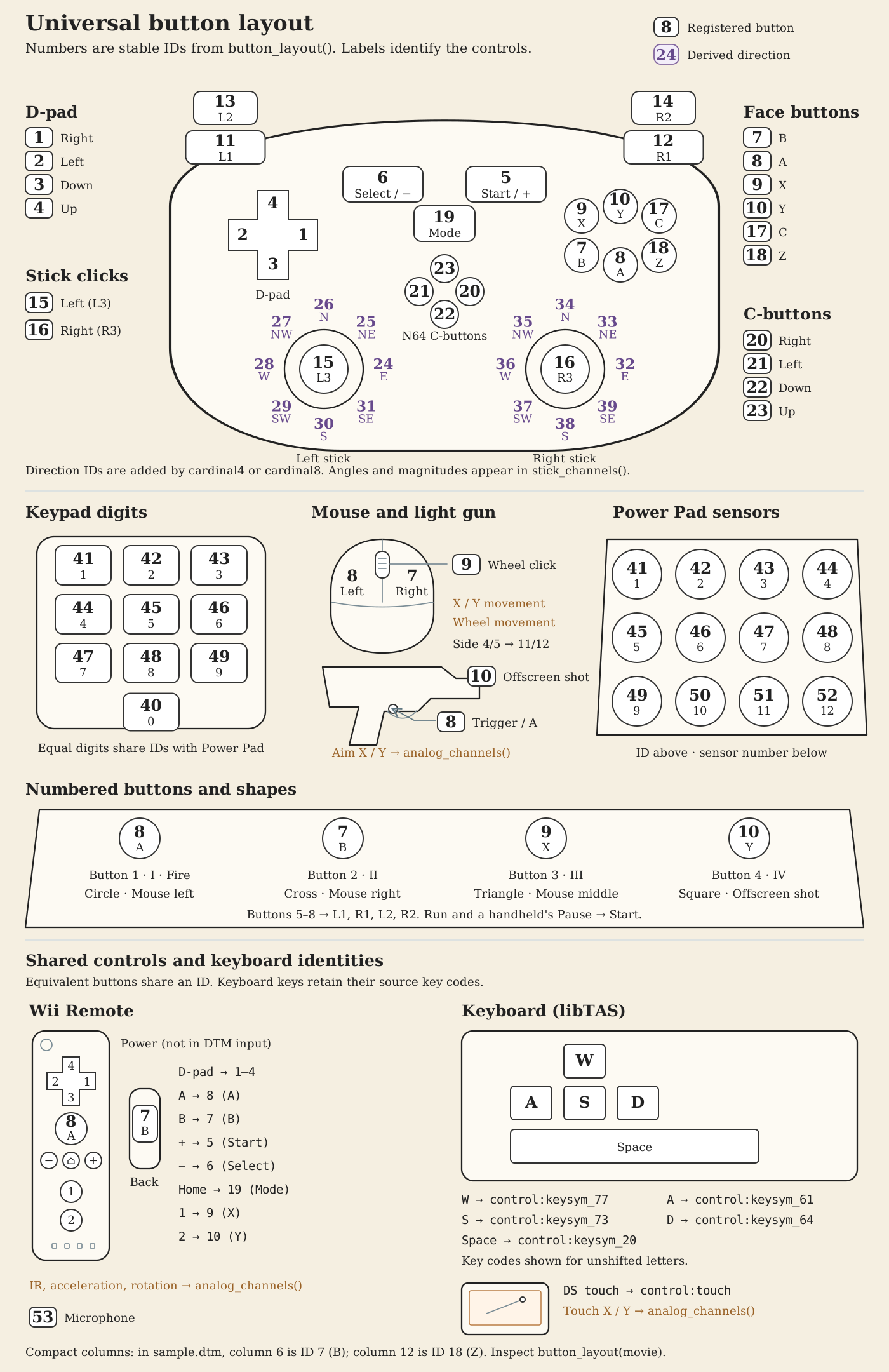
Every control of a recording has an ID from a shared registry, which
button_layout() reports beside the control’s key and its
label on the device. The registry contains 53 consecutive IDs. The same
rules decide in every reader which controls share an ID, so a console
has the same IDs whichever emulator recorded it:
- By label. A button that carries one of the registry’s letters or words (A, B, C, X, Y, Z, L, R, Start, Select, Mode) has that ID. The ID follows the letter, not the place on the pad: A is the right-hand button of a Nintendo pad, the left one of a Genesis pad, and the lower one of an Xbox-style pad, which is what a libTAS recording of an SDL game controller holds.
- By place, for PlayStation pads. Their buttons carry shapes and have the IDs of the SNES buttons in the same places.
- In order, for numbered buttons. The first is A, then B, X, Y, L1, R1, L2, and R2.
- By role, for the rest. The table lists every such assignment.
button_layout(movie)$name shows the label on the device
beside the shared key and id.
| Source controls | Shared control and ID |
|---|---|
| Arcade and joystick buttons 1–8 | A, B, X, Y, L1, R1, L2, R2 (8, 7, 9–14) |
| Arcade buttons shown under a cabinet’s name: Attack or Punch; Jump, Jump/Start, or Missile; Kick; View change | A (8); B (7); X (9); Select (6) |
| Atari 7800 second trigger | B (7) |
| Channel F stick: forward and back; twist left and right; push and pull | Up and Down (4, 3); L1 and R1 (11, 12); A and B (8, 7) |
| GunCon trigger, side A, side B, and offscreen shot | A, B, X, Y (8, 7, 9, 10) |
| Intellivision Top | X (9) |
| Keypad Clear and Enter; keypad Star and Pound | Select (6) and Start (5) |
| Keypad digits 0–9 and Power Pad sensors 1–12 | Equal numbers share numbered_0–numbered_12
(40–52) |
| Lynx Option 1 | Select (6) |
| Master System 1 and 2; UFO 50 Fire 1 and 2 | A, B (8, 7) |
| Mouse buttons 4 and 5 | L1 and R1 (11 and 12) |
| Mouse left, right, and middle buttons | A, B, X (8, 7, 9) |
| Mouse wheel up and down | C-Up and C-Down (23, 22) |
| Neo Geo A, B, C, and D | A, B, X, Y (8, 7, 9, 10) |
| Option buttons and mode switches: Jaguar Option, Lynx Option 2, PC Engine 2/6-button switch, PC-FX Mode 1 and 2 | Mode (19) |
| PC Engine and PC-FX I–VI | A, B, X, Y, L1, R1 (8, 7, 9–12) |
| PlayStation Cross, Circle, Triangle, and Square | B, A, X, Y (7, 8, 9, 10) |
| Single fire button or trigger; light-gun trigger | A (8) |
| Start and pause buttons: 3DO P, Dustmod Escape, Jaguar Pause, Lynx Pause, Neo Geo Pocket Option, PC Engine Run | Start (5) |
| Super Scope trigger, cursor, turbo, and pause | A, B, Mode, Start (8, 7, 19, 5) |
| Touch on a screen or touchpad | L3 (15) |
| Wii Remote 1/2, +/−, and Home | X/Y (9/10), Start/Select (5/6), and Mode (19) |
Wii Remote D-pad and A/B buttons use the gamepad IDs. Nunchuk C/Z use 17/18, Classic Controller buttons use the corresponding gamepad IDs, and libTAS Guide uses Mode. The microphone uses ID 53. Genesis and Saturn C retain ID 17 because those controllers have separate C and X buttons.
A shared ID says that two buttons are the same control; what a button
does still depends on the game. Keyboard keys keep the code set of their
source. For example, a Neo Geo D button uses Y (10), while a libTAS
keyboard D keeps control:keysym_64. Each device of an
openMSX recording is a controller of its own, listed in
header$controllers, with the IDs of its kind. Of two
direction pads, the left one is the direction pad (IDs 1–4) and the
right one has the IDs of the N64’s C-buttons (20–23): the Virtual Boy’s
pads and the WonderSwan’s X and Y crosses. An arcade cabinet’s two
joysticks have the direction IDs of the left and the right analogue
stick. The Intellivision disc has the eight direction IDs of the left
stick; a direction between two of them, such as NNE, sets both. Where a
core logs the disc as two axes, its sixteen directions are those the
console reads from them. Buttons on the console itself, such as Reset,
the Master System’s Pause, or the lid of a DS, are not part of a pad;
system_channels() returns them.
A Doom-engine demo stores no buttons at all. It stores what the game
was asked to do in each tic, whatever keys the player had bound: attack,
use and, in Hexen, jump. These game actions are kept apart from device
buttons. They have kind action and IDs of their own
(action:attack, action:use,
action:jump), shared by every game that records the same
action. A Dustmod script likewise holds jump, dash, light and heavy
attack, taunt and restart as actions; its jump is the same
action:jump. A GoldSrc demo (Half-Life,
Counter-Strike 1.x) stores sixteen actions with every command,
attack, use and jump among them, and the movement and view angles the
command asks for as numeric channels. Numbered IDs are kept for what a
player does to a device.
Format references
The table links the relevant specifications and serialisation
sources. Component-level provenance is included in the installed
package; locate it with
system.file("COPYRIGHTS", package = "replayr"). The
original examples under inst/extdata/ exercise supported
layouts, including device combinations absent from the published
collection; their generators are under tools/ or alongside
the unit tests.